Showing posts with label Race. Show all posts

Tuesday, June 1, 2010

"Brownstones to Red Dirt"

Ruth/Rachel: This is a SIFF blog to be graded for extra credit

Brownstones to Red Dirt is a film about two groups of grade school students that are pen pals with each other. One group is from Bed-Stuy in Brooklyn, NY, USA. The other is from Freetown, Sierra Leone. The children from Bed-Stuy are living in a neighborhood which has been historically known for high rates of crime, especially murder as well as poverty. The school children from Bed-Stuy attended the Urban Environment School that was built in between two housing projects. This school was designed to provide an enriching educational environment that would not have been available otherwise. The Freetown kids were mostly orphans of civil war and attended the Children In Crisis School that was run by three Auntys, one of whom had originally rescued many of the children during the war. The Children In Crisis school was a safe haven for these children, but was overcrowded and lacking greatly in materials, food, water and medicine.

The children from both countries created strong bonds with their pen pals and learned more about each-other's situations. One really positive aspect of the sharing was that the kids in Bed-Stuy felt motivated to reach out to the kids of Freetown by hosting a fundraiser for the Children in Crisis school. They ended up raising about $1000 and providing serious aid to their pen pals. This funding was able to provide bedding, medicine and educational resources. I think that this helped show how even in the position of a child in an area known for poverty you can still make an impact and create a change for social justice that you care about. It also shows that there is a need for unity among all peoples. Malik, one of the students from Bed-Stuy's closing words of the film say it well. "People. Friends. Other countries. Tokyo. Sure I’m black. Sure you’re black. Sure you’re white. Sure you’re Spanish. Sure you’re Hindi. Doesn’t matter. We’re still people."

A few of the other Bed-Stuy kids address race briefly. Fred, who is African-American says he feels stereotyped against because he is black. He says that people assume that he fights and gets into trouble and that he is just "a black piece of dirt." He also was hesitant to begin skateboarding, his now favorite hobby, because he thought it was something that only white people did.

This film passed the Bechdel test for gender and for race. In fact I do not recall anyone in the film who was not a person of color. Though on screen we saw communities of color being represented, I feel that it should be noted that the director and writer (who were also producers for this film) were both white men. Not to degrade any of the work that they have done but to be aware of the fact that even when people of color and women are represented on screen they are not often behind the screen in positions of power. In the case of this documentary even though people of color and women are telling their story, the are still seen through the lens of white males.

Photos From:

Quote From:
Malik in Brownstones to Red Dirt (Dir. LaMattina, Walker, 2010)

Thursday, May 27, 2010

Lose the Fear.

Ruth/Rachel: This is not for grading about a SIFF film


"A life lived in fear is a life half lived"- Anonymous
and that doesn't just go for the guys.

This side entry does not deal much with the media, but I wanted to post about it as an ally to African-Americans and lower class people, as well as some big connections I see between myths about these oppressed groups and violence against women. This is me speaking out on something that I do not feel is right.

Today on a social networking website I received a mass warning from a friend to watch out for a man who had been attacking women in the Seattle area. The only information included in the warning about the man was that he was Black and that women should 'be careful'. Some responses to this warning included one woman saying that she had a 'creepy' black homeless man near her work and that she would be cautious around them today. Though I appreciate a warning of an attacker on the loose, I find some serious problems with the way this information was communicated. Seeing this simple warning unfold today really made me see a lot of connections between the myths surrounding gender violence and stereotypes about race, class, and gender.

Though Seattle has a small African-American population 8.4%, it is the highest of west coast cities other than Los Angeles. Among this population exists friends, family, colleagues, respected professors, leaders, community members, and advocates working against gender violence. So why is being Black used as the sole descriptor of this attacker? As a woman, should I go to class tomorrow and be suspicious of my Black male professor who is an ally for gender equality? Should I assume I need to protect myself from my classmates who are African-American men? No. The reality is that there are unfortunately many, many, many white men who attack women. Life is not a D.W. Griffith movie! Black men are not ravaging animalistic rapists on the search for their next (white) female victim! Realistically solely telling the information that the attacker is a black male with no age or other identifying characteristics leaves us a huge amount of people that one is supposed to suspect as a possible attacker and is not helpful much at all except for re-instilling myths about attacks on (white) women being carried out by black men.

Another piece that is brought up is myths about class. Often people in the lowest class or those who are sometimes seen as out of the class system, the homeless are regarded as dirty, mentally unstable and criminal. The myth that homeless strangers and vagrants are most likely on the search to commit alley way rapes and assaults on women is not very representative of most assaults. In reality, 7/10 female sexual assault victims know their attackers (Dobrovolny). The reality that most attackers are not homeless strangers brings up the rape myths that are put in place to scare women.

Rape is one of the worst crimes but is often taught to us in myths that are not true. Women are taught to be afraid of going away from the home in order to avoid rape and sexual assault. Truthfully 3/4 of all violent attacks occur within 5 miles of the home (Dobrovolny). So staying in the home and being Suzie Homemaker is not the ticket to safety from violence. Women are also told that if they do leave home they definitely need to 'be careful'. What does that even mean? Make eye contact/don't make eye contact? Be obvious/don't be obvious? Carry a weapon/don't carry a weapon? Most attackers are not strangers and these puzzling solutions may even make the situation worse.
Some strategies for preventing sexual assault that are more effective then these common ones are to:
  • Clearly express boundaries
  • Watch out for controlling behaviors, signs of violence and disrespect
  • Educate yourself on rape myths
  • Trust your inner voice
  • Know who you are hanging out with
  • Don't pass out in private
It is important that women do not restrict themselves from public mobility because they fear assault. They are limiting themselves and placing their fear in the wrong place. It is important to dispel the myths about race, class, and gender especially when it comes to situations of violence. If we break down the myths, we can redirect our energy into educating people on truly effective strategies to preventing violence and can bridge gaps to communities that are too often given the role of scapegoat in violent crimes (among other things.)


Assault Statistics from:
"Road Worrier" by Michell Dobrovlny

Sexual Assault Prevention Strategies from:
Rachel David's "Gender, Violence, and Social Change" course

Tuesday, April 20, 2010

Noble Magic Tricks

NOTE: there may be spoilers of The Green Mile, Pocahontas and Avatar if you have not already seen these films. Also Ruth/Rachel this is the post I would like graded for week 4.

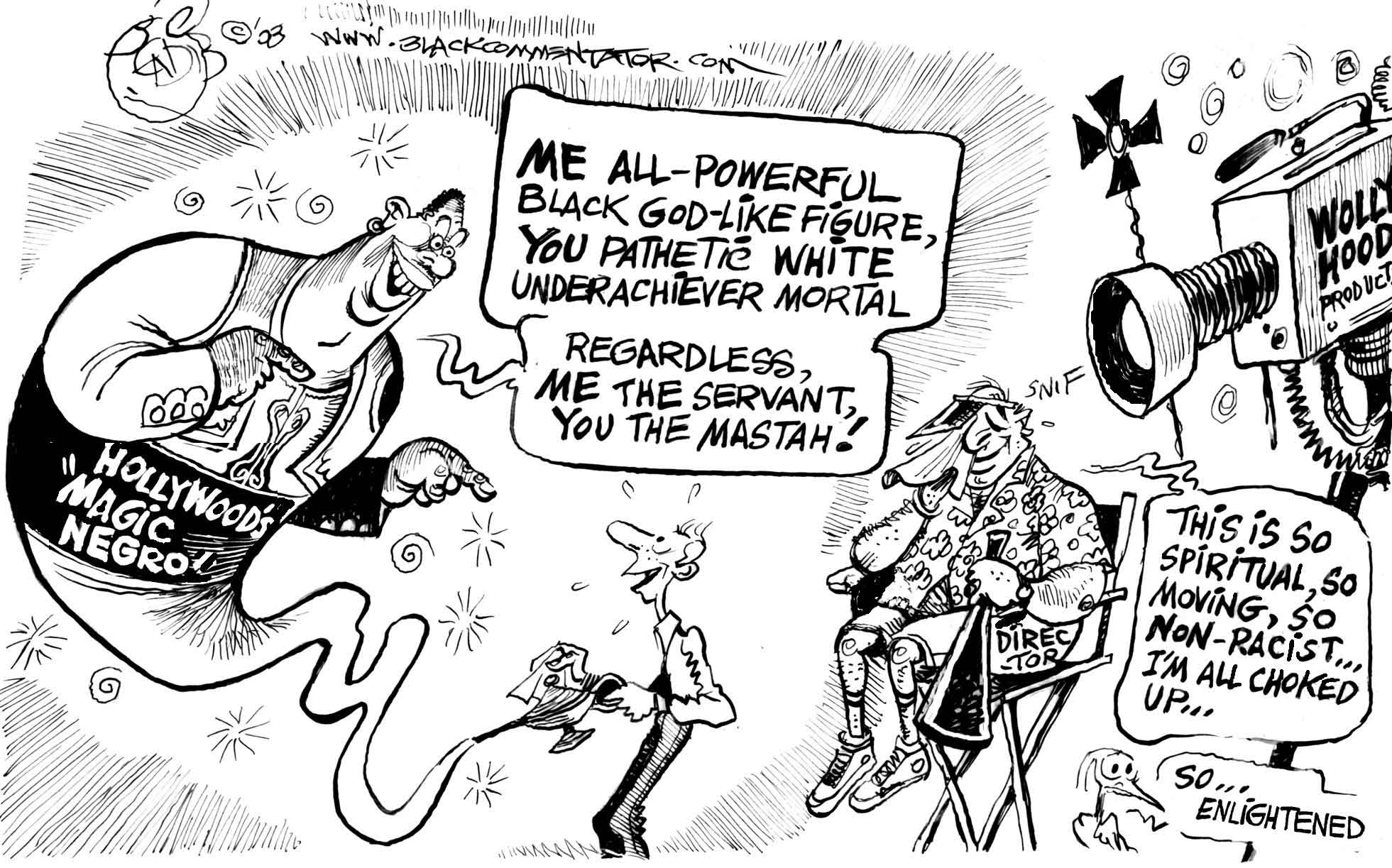
(please click the cartoon to view the full image)
This week I want to focus on one popular stereotype of people of color that is seen in film, "The Mystic". This can be seen in the forms of the 'Noble Savage' (in Native Americans and Indigenous peoples) and as the 'Magic Negro' (in Blacks). Some other common characters I mention include the 'White Messiah' who come to save the day for people of color and the classic white protagonist with a friend who is a person of color.

The noble savage is seen in almost all depictions of Native Americans in film. Pocahontas and Avatar are two films that show both the 'Noble Savage' and the 'White Messiah' and in fact have these two characters in a romantic relationship together. Interesting to note that in both cases the savage is both a woman and indigenous and the messiah is a white male. Placing the messiah in the position of power and the savage overpowered both by race and gender.

In Pocahontas, the relationship

exists between John Smith (White Messiah) and Pocahontas (Noble Savage). Pocahontas is very in tune with nature, she talks to animals and considers them part of her family. As well, she speaks with a spirit tree which shares the heritage of her people and sees the future. She does make the point that she does not want to be labeled as a savage in the song "Colors Of The Wind" (Thomas, 1995):
"You think I'm an ignorant savage and you've been so many places, I guess it must be so, but still I cannot see. If the savage one is me, how can there be so much that you don't know?"
However, she goes on to prove that she is not a savage by expressing her unity with nature. John Smith learns some of Pocahontas's culture of embracing nature but tells her of the right (European) way of life, the importance of gold and tells her how to be civilized. In the end John Smith (with a little help from Pocahontas) stands between the battle of the colonizers and Pocahontas's tribe and to save the day.

In Avatar Jake Sully plays the "White Messiah" and Neytiri plays the "Noble Savage". Their story follows along almost all of the same lines as Pocahontas, Jake Sully is sent to make diplomatic compromise to obtain a natural resource from Neytiri's people, the Na'vi. Neytiri is very connected with nature and like Pochahontas speaks with and prays to a magical tree that is the lifeblood of her culture. Throughout the disputes with humans, saving grace Jake Sully leads the Na'vi people in battle and his tactics and techniques once again save the day. Both of these examples show the message that though noble, indigenous people are unable to stand up for themselves and they will always be uncivilized.

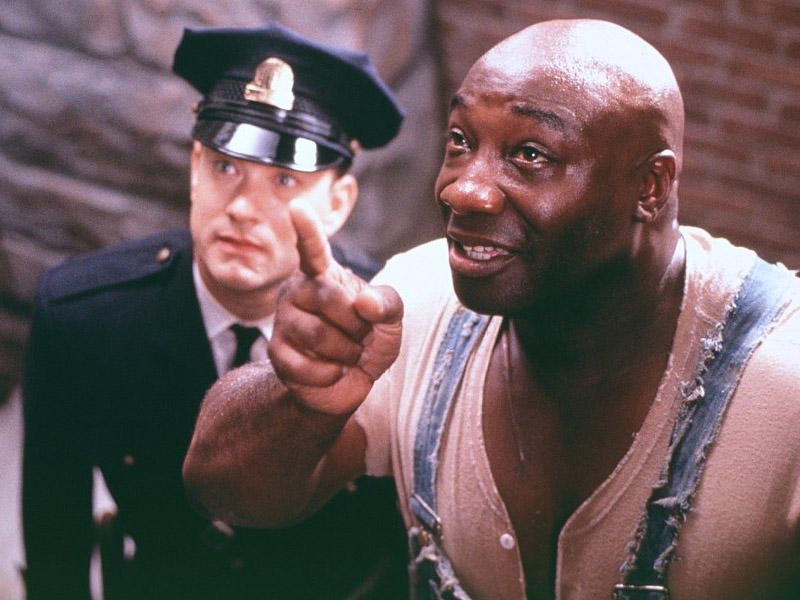
Another interesting relationship developed between the mystic of color and the white protagonist are friendships between the 'Magic Negro' and the white protagonist. One clear example of this is in The Green Mile. In this film the 'Magic Negro' is John Coffey (Michael Clarke Duncan) and the white protagonist is Paul Edgecomb (Tom Hanks). John Coffey is the bearer of a great healing power, but it does little to change his own situation. He is a poor, uneducated man who is accused of the rape and murder of two small white girls and spends the majority of the film behind bars. Coffey and Edgecomb develop a sort of friendship as Coffey begins to show his truly docile nature and displays his magical powers. Despite his great power Coffey continues to humble himself and calls Edgecomb "Boss."

Coffey's greatest achievements in this film in his magical healing of white people. Coffey takes away Paul Edgecomb's urinary tract infection and heals the warden's wife of her grave illness and tumors. When Coffey heals these illnesses they become a sickness inside of him before he coughs it up. Even the way that Coffey uses his magic symbolizes taking the burden off of white people and places it on himself. In the end of the film despite all of John Coffey's spiritual power and despite proving his innocence by transmitting the memory of the true attack to be seen in Edgecomb's mind he is still killed. The 'Magic Negro', regardless of strength, wisdom, or power, is bound to the chains of white man's wants and ways.

The mystic stereotype of people of color oversimplifies them. Just as white characters are complex and developed more like real people, characters of color should be as well. There is more than one dimension to any person, regardless of race. Additionally, when fewer roles exist for people of color and one-dimensional stereotypical roles are the majority of what is offered the perpetuating message is that people of color are rarely seen and one dimensional, if not just invisible.

I enjoy all of the films that I have discussed in this entry and believe each have strong narratives and entertainment value. Additionally, all of these films have had some progressive steps in terms of discrimination. Sully, the hero in Avatar is differently- abled. Pocahontas features Native voices for all of its Native characters and shows the second Disney princess of color. Michael Clarke Duncan received an Oscar nomination for his supporting role in The Green Mile. Despite these progressions I wanted to bring up the underlying themes of oppression which exist in these films, as to better understand and be aware of the stories that they truly telling. A movie can be compelling, entertaining, and moving while still spinning the wheel of oppression. And many still are.

Images from: