Showing posts with label Ethnicity and Whiteness. Show all posts

Sunday, May 23, 2010

"Farsan": Comedic Masculinity

Ruth/Rachel this is SIFF blog 1 for regular grading.
There will be spoilers of Farsan in this blog entry.
The first film I went to see in the Seattle International Film Festival was Farsan. The film centers on Aziz, an older man seeking a new lady. Aziz is a first generation Middle Eastern immigrant to Sweden who works in a bicycle shop. He lives a quiet life but is seeking some more companionship as he misses his deceased wife. He is looking forward to the expected birth of his first grandchild and is seeking a new wife.


Ethnicity is highlighted in this film mostly through Aziz and Aziz's coworker Juan. The expressions of ethnicity are also very deeply tied to masculinity. In the case of Juan's ethnicity is not specifically stated, but he is a Spanish speaker and shows some elements of the Latin Lover. He is an older 'ladies man' who has multiple dates and dances with mulitple women. He even ends up serving lamb testicles claimed as an aphrodisiac at a double date with Aziz. Aziz's ethnicity is explored in his interactions with women that could be regarded as more culturally suited for an older time and his nation of origin. His dress and a hasty marriage proposal to one woman show this. As well, Sami, Aziz's son feels a great pressure from his father to have grandchildren and carry on the seed, so much so that Sami and his wife fake a pregnancy approaching a pending adoption to cover up Sami's infertility. Aziz displays some traits of a stereotypical first generation immigrant parent. Though traits of these stereotypes are visible the characters have more complexity beyond these traits. Though this film did not pass the Bechdel test for gender it passed for race (counting Middle Eastern people as a race).


The emphasis on masculinity among the characters of Aziz and Juan is also shown in their relationship with each other. They often say "Macho, Macho" after their displays or stories of masculinity and talk about how 'well endowed' they are. Their macho masculinity transfers to their boss Jörgen after Jörgen expresses that he has sex with his wife less often than the other men find fitting. Aziz takes Jörgen under his wing to teach him how to be macho and win more affection from his wife. Aziz takes him on fulfilling extreme dares pushing him out of a car and down mounds of rocks to 'make him strong.' Jörgen takes proving his masculinity to an extreme by picking fights with his wife, Lotta to assert control, getting a tattoo of a bull that says 'DEATH' and making a "macho salad" crushing vegetables hilariously with his body for Lotta. Lotta rejects this new behavior and wants him to return to his 'wimpy' self. Jörgen's character shows the extremes that proving masculinity can go to and how comical it can be trying to achieve unattainable standards of gender roles.

Overall, I enjoyed this film quite a bit and would recommend it to other SIFF goers and felt it had a thought provoking commentary on masculinity.

Photos Courtesy of:
Trailer Courtesy of:

Monday, April 26, 2010

Mirror, Mirror on the Wall, Who's the Whitest of them All?

Ruth & Rachel: This is the entry I would like graded for week 5
What is whiteness? According to the Merriam-Webster Dictionary:
White:
1 a : free from color
2 a : being a member of a group or race characterized by light pigmentation of the skin b : of, relating to, characteristic of, or consisting of white people or their culture c [from the former stereotypical association of good character with northern European descent] : marked by upright fairness

3 :
free from spot or blemish: as a (1) : free from moral impurity : innocent (2) : marked by the wearing of white by the woman as a symbol of purity.... c : not intended to cause harm d : favorable, fortunate
I think this definition brings up a lot of interesting aspects about what it means to be identified as white. Though the racial definition refers to people of the caucasian race with light skin pigmentation, the pieces of the definition that aren't specifically related to race are often applied to the social definition of what it is to be white. The common stereotypes of white people being morally pure, correct, fortunate and favorable come from the use of the word white to associate these positive characteristics with the race group. As well, the piece of the definition that refers to white as a lack of color shows the separation of white from all other races as the opposite of people of color, showing that the clearest image of white people is a pale, blonde with light eyes. This may also be a reason for which depictions of once non-white ethnicities were (and still are) often darker in skin tone, hair color and morals.

Several ethnic groups that were once not
considered white in the United states now are. Irish, Italians, Jews, Arabs and several other groups have over time become partially or fully integrated into the ever-changing definition of white as a race. I find interesting how Arabs are identified as white in the United States census, but are not in the Canadian Census. The Canadian Census of 2006 included Arabs and West Asians as categories in question 18. Part of the reason Arabs are included as white in the U.S. census is that about a century ago Arab immigrants petitioned for inclusion in order to avoid discrimination. Though Arab Americans are placed in the white race category by the census and by some of society, they are not treated the same as other white people, nor do they benefit from white privilege to the same degree as other white Americans. This differential treatment can be seen in early film as well as media today.

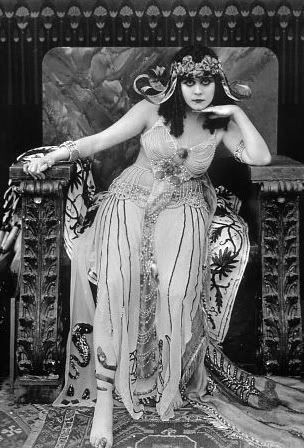
Two early film depictions of Arabs showed actors who were not themselves Arab, but whose races were in the process of assimilating into whiteness. Theda Bara was known for her vamp character and was placed in dark makeup and revealing sexualized clothing. A good example of this is her role in Cleoparta where she is covered in snakes and has a dark curly wig and very thick eyeliner. She was also an image of sin and her name was an anagram for "Arab Death." Though Bara carried this image of the dangerous sexual Arab woman well, she is actually of Jewish Ancestry. Ruldolph Valentino also showed a sexualized aggressive Arab character among his "Latin Lover" persona. In his role as The Sheik he is an exotic sexual creature preying on a white woman. Valentino molds well into this Arab character of exotic sensuality, but he is not truly Arab, rather of Italian descent. I suspect that these early roles of Arab characters were given to Jewish and Italian actors because they were not yet assimilated into whiteness so shouldn't be given white roles, but looked "dark enough" by the filmmakers standards to pass as Arab.


Today most media depictions of Arab people are connected to terrorism and the American perception of Islam and continue to be dark in image and character. After the 9/11 terrorist attacks Arab people have been bombarded with stereotypes. In the news Arab men are still seen as aggressive but women are often seen as very oppressed and nonsexual. Many of these stereotypes stem from mass depictions of Islamic Fundamentalists who are extremely violent and not representative of the majority of Muslims or Arabs. Additionally Arabs come from all faith backgrounds, many being Christian.

Attaching religion to ethnicity seems to be part of the struggle to assimilate into whiteness. Several of the groups which had to assimilate did not fit the Protestant requirement of the American WASP (White Anglo-Saxon Protestant). The wave of Irish and Italian immigrants in the mid-late 1800s brought many Catholics. Jewish immigrants also brought a new faith. As well the assumption that all Arabs are muslims has affected how they are treated differently than other white Americans. I think that in order to better serve the Arab American community the stereotypes about them need to be broken down and in terms of the census they should be granted their own race or ethnicity section in order to better allocate resources. Arab Americans are faced with different stigmas than other assimilated white ethnicities and should not be treated by the government with the assumption that they are the same receiving white privilege.

Video: Clip of The Sheik courtesy of Youtube
Images: